Wednesday, July 14, 2010

Campbellford to Hastings

It rained for a very short time just as we were getting up and while it was overcast, the weather report indicated that the most of the serious rain had passed. So while Captain Mark took advantage of the reasonable fuel prices in Campbellford, I ran over to the local farmer’s market. I love to make jams and jellies so whenever I get the chance to purchase other homemade jams, I grab the opportunity. At this farmer’s market I found rhubarb jam and some fantastic looking tomatoes.


We found our place behind Summer Star, our newly acquainted boat buds, Ron, Sally and Frank (their darling Dachshund). We met them upon arrival in Campbellford when Ron graciously shared his electric connection with us…I guess you could say this “sparked” our friendship.

All of the traditional locks in Canada have the steel cables to which we secure our lines. In the States when using a cable connection, we just secure one line mid-ship but the lockmasters in Canada require that we secure both bow and stern. Last year I made special shorter lines just for working with the cable-type securing. These lines have worked great for the stern but the distance between the cables on the lock walls have required that I use the traditional length bow line while Mark uses the short lines at the stern. This way I can adjust our forward-backward movement as needed with the longer line.


There were six locks today which included one double lock set. It continued to be very so hot. Even though there were half as many locks as our first day on the T-S Waterway I think today’s travel wore us out more due to the spacing of the locks. No sooner would I get settled into my knitting to relax when another lock would appear.


We only went 18 nautical miles today but it took us over five hours.
When we reached Hastings we had the choice of either staying on the lock wall (with no electricity) or going into the marina…at the last lock, while literally melting, both Summer Star and the Lolligag enthusically decided to stay at the marina for a wonderfully air conditioned sleep.

After getting settled in at the marina, we were all going to have dinner at the Captain’s Table in downtown Hastings. Unfortunately, Frank was not feeling well so Ron and Sally did not want to leave him. While Ron got carryout, Mark and I had the outstanding fish, chips and shrimp. Believe the rumors…this was exceptional fish.

We were so tired and the air conditioning felt so good that we were asleep before the sun went down…

Hours on the water: 5
Nautical miles traveled: 17.9
Number of bridges to be opened: 1
Time spent waiting at bridge: 0
Number of locks: 6
Next Destination: Peterborough
What we are listening to: Harry Potter and the Deathly Hallows
Lesson for the day: Paying for the electric (AC)= a good night's sleep in 90 degree weather
Obligatory knitting report: Finished Opal socks for Captain Mark

Tuesday, July 13, 2010

Campbellford Ontario


Dottie and I let Captain Mark sleep in a little bit this morning to recover from our physically stressful day yesterday. Later in the day while I worked on the blog, Mark and Dottie set out to explore the town.

Located approximately midway between Toronto and Ottawa, Campbellford was first settled during the 1830s. A wealthy community at the turn of the twentieth century, Campbellford is home to many fine Victorian homes. Today Campbellford is notable as the home to Empire Cheese, which is eastern Ontario’s only remaining rural cheese and butter co-operative.


An eclectic tourist attraction is the 27 foot high statue of a Toonie (the unofficial name for Canada's two-dollar coin) which was designed by local artist Brent Townsend.


Word along the T-S Waterway spread quickly to let us know that the best fuel prices could be found in Campbellford. Captain Mark and Dottie scoped out the fuel docks as they walked around downtown and determined that the cost of diesel fuel when converted to US measurement was $3.80 per gallon.

Monday, July 12, 2010

Trenton to Campbellford


The locks on the Trent-Severn Waterway open for the first lock through at 8:30a, so we were up early and on our way. On this first day we will pass through twelve locks with the last two locks being a double flight. In addition to the twelve locks there were two swing bridges that also needed to be opened for us.


Many of the lock doors on the T-S Waterway are manually opened by lock attendants. There will be an attendant on each side of the lock wall and each will “walk” the turnstile around to open or close the lock door. As you can see from the photos, they are also masters of multi-tasking because while the lockmaster was opening the door for us, he was also calling ahead to the next lock to let them know that we are headed in their direction.


The landscape during our travels was very diversified – from the urban areas with the man-made canal to the primitive wetlands.


As the day wore on and the heat/humidity increased, we wore down physically. Personally, I did not think that we were ever going to come to the last flight of locks # 11 & 12 with the city of Campbellford just beyond. We knew that a major storm was headed in our direction and we felt pretty confident that we would make Campbellford before the storm hit. However, we were incorrect. We had just entered the lower of the two connecting locks when the rain first began. It had been so hot that the rain felt good and I think the rain drops even sizzled as they hit my hot skin. The combined lift on these two locks was 48 feet and by the time we had partially lifted the first 24 feet,and were ready to proceed into the second lock, the storm intensified with rain literally coming down in sheets and lightening striking the ground immediately outside the lock. As crazy as it seems, we were really lucky to be where we were when the torrential rain and lightning came. Due to the fact that we were in the lower of the two locks we were protected, especially from the lightening. The lockmaster told us that he would not raise us any higher or into the next lock until the squall passed due to the wind and the lightning. So Mark and I tied off the boat and came inside to change our clothes when the rains started to let up a little. We were both totally soaked. The storm passed within twenty minutes and the heat came back, not quite, but almost as bad as before.


The city of Campbellford provides dockage on canal walls in the heart of downtown. Clean restrooms as well as a great internet signal were all the incentive we needed to stay an extra day to rest and recover.

Hours on the water: 8
Nautical miles traveled: 27.4
Number of bridges to be opened: 2
Time spent waiting at bridge: 0
Number of locks: 12
Next Destination: Hastings, Ontario
What we are listening to: Harry Potter and the Deathly Hallows
Lesson for the day: The storm was exciting and thrilling but I am glad we were safe!
Obligatory knitting report: Regular sock for Captain Mark with Opal Yarn

Sunday, July 11, 2010

The Trent–Severn Waterway


The Trent–Severn Waterway was formerly used for commercial purposes but now is exclusively for pleasure boats, connecting Lake Ontario at Trenton to the Georgian Bay portion of Lake Huron at Port Severn. Begun in the 1850’s, ironically by the time the waterway was completed in 1920, its design had been made obsolete by larger boats and the railroads as the waterway had been designed for boats too small to be commercially viable.

The major natural waterways include the Trent River, Otonabee River, the Kawartha lakes, Lake Simcoe, Lake Couchiching and the Severn River. The total length of the waterway is 240 miles, beginning at Trenton, Ontario, with roughly 20 nautical miles of man-made channels. There are 44 locks, including 36 conventional locks, two sets of flight locks, hydraulic lift locks at Peterborough and Kirkfield, and a marine railway at Big Chute which transports boats between the upper and lower sections of the Severn. The system also includes 39 swing bridges and 160 dams and control structures that manage the water levels for flood control and navigation on lakes and rivers. It is maintained and operated by Parks Canada, a federal government agency, and now is being used for tourism by recreational boaters.

Trenton Ontario

It stopped raining early Saturday morning but the heat and humidity just continue to make it extremely uncomfortable…I don’t think that we could leave Picton fast enough…if it was possible to leave skid marks on the water – we would have done so leaving the Picton Marina.

We had a leisurely ride to Trenton, Ontario which is town located at the beginning (southern end) of the Trent-Severn Waterway. Traveling on the open waters of Picton Bay was wonderfully refreshing as we were able to take advantage of the cool breeze. We watched as two seagulls had lunch.


We found our spot at the Fraser Park-Trenton Marina which is strategically located at the mouth of the T-S Waterway. Different marinas and towns have different flavors and as icky as the Picton Marina was, the Trenton Marina was delightful. The staff was fun, welcoming and most accommodating which always makes a stay easier.
We used the time to walk around the town once the sun went down a bit and found a great grocery store, the Metro which is an A&P but certainly not like any in the US…it was clean and well stocked. We purchased ribs which were so good that I sent Captain Mark back on Sunday to get another batch.

I also had another treat in Trenton…when inquiring about a Laundromat, I was told by the marina owners that a laundry service was available and that I would be very pleased with the end product…since the Laundromat was at least a half a mile walk and the temperature was back up in the high 90s, I quickly took advantage of this charming soul who would come to the boat, pick up my dirty clothes and then return them to me in less than four hours. Normally, I enjoy doing laundry but with this heat, having someone else do the wash was my idea of heaven. I could not have been more pleased…the clothes came back promptly and folded in exactly the same way I would have folded them. This service was a little pricey…but just this one time it was a perk I was willing to pay for!


All day Sunday we rested and read about the upcoming Trent-Severn Waterway experience. Just about every person who has done this Loop trip has commented that the Trent-Severn Waterway and Georgian Bay were the highlights of the trip so we are most excited to start this next leg of the journey.

Hours on the water: 4.75
Nautical miles traveled: 36
Number of bridges to be opened: 0
Time spent waiting at bridge: 0
Number of locks: 0
Next Destination: Campbellford, Ontario
What we are listening to: Harry Potter and the Deathly Hallows
Lesson for the day: It was nice having someone else do my laundry for a change.
Obligatory knitting report: Second blue sock for Wunder Kid Mark

Friday, July 9, 2010

Picton Ontario


Upon arriving in Picton Marnia I was in for the rudest docking awakening yet …as I hopped off the boat to secure the lines (as there was no deck hand to meet us, which was okay) I nearly fell off the pier. The docks which are floating docks are so wobbly that the only thing that saved me from continuing to topple over into the water was the fact that instinctually I hit the deck to secure my balance. No other boats were secured to our pier and I was not sure if that was because no one else wanted to experience this thrill-ride or if they just chose not to stop in Picton. Most of our friends who have come to Picton had anchored out and I can certainly understand why…but since it has been so hot we wanted the electricity in order to run the AC.

After I had calmed down and gathered my courage to once again step on the pier, we decided to explore the actual town of Picton. It is now about 105 degrees and the heart of town is literally straight up the side of a mountain. By the time we reached the top of the hill, we were in serious need of a cooling station and water. We found the most charming bookstore with a coffee shop to regroup before we explored some more. I found a yarn shop and was forced to purchase some hemp/Merino blend yarn for socks for Captain Mark.


It rained through the night but the rain did not make the humidity go away and the rain continued off and on throughout the day on Friday. So we just stayed inside the boat for the remainder of our visit to Picton. Mark read, Dottie slept and I alternated working on the blog and knitting. It was early to sleep Friday evening as the rain continued…

Thursday, July 8, 2010

Kingston to Picton


It continues to be just brutally hot so we left Confederation Basin in Kingston rather early in an attempt to catch cool sea breezes on Lake Ontario. As we headed west we travelled along the channel north of Prince Edward County which is a large island in Lake Ontario with our destination as Picton located in PEC.

The water and winds in this particular portion of Lake Ontario make for some of the best and most challenging sailing in the world. People come from all over the world to test their skills in these waters. When the 1976 Summer Olympics were held in Montreal, the sailing venue was held in Kingston to take advantage of this natural phenomenon. An ironic and humorous fact is that a special marina was built for the 1976 Olympics and is located immediately adjacent to one of Canada’s maximum security prisons. The area joke is that this marina is where the convicts keep their yachts!


We were extremely surprised to see a US Coast Guard ship docked not far from the prison/marina and of course we made up all sorts of stories to explain why a USCG vessel would be in Canadian waters near a maximum security prison. I just knew they were after me as they must have found out how much yarn I had smuggled into Canada…


The ride was calm and rolling with barely one foot waves. The scenery was peaceful and quite beautiful.


Hours on the water: 4.5
Nautical miles traveled: 34.5
Number of bridges to be opened: 0
Time spent waiting at bridge: 0
Number of locks: 0
Next Destination: Trenton, Ontario
What we are listening to: Harry Potter and the Deathly Hallows
Lesson for the day: It is so hot!
Obligatory knitting report: Finished blue socks for Wunder Kid Mark

Wednesday, July 7, 2010

Martello Towers and Fort Henry


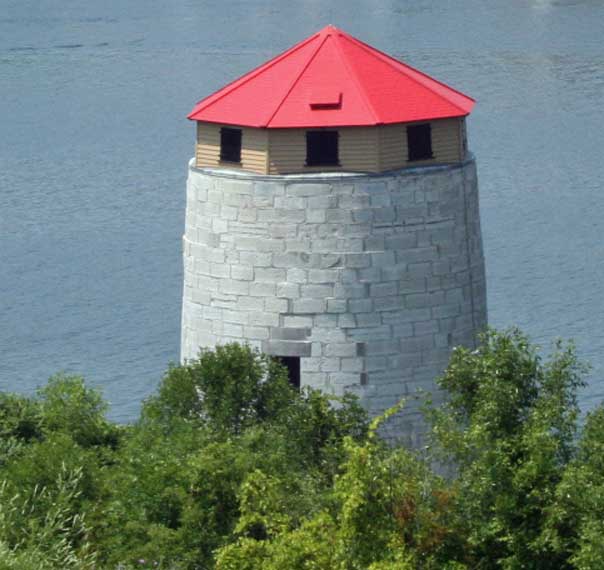
As we approached Kingston and our slip at Confederation Basin we could not help but notice several large round block structures with a hint of painted wood near the top and pointy roofs. At first they looked like the round red barns of Indiana but upon closer inspection it was obvious that they were not barns. Before the dock hands had even finished tying our lines, I was asking a millions questions about these buildings, especially since there was one immediately at the end of our pier. I was informed that they are Martello Towers, but simply called Martellos.

They are small defensive forts built in several countries of the British Empire during the 19th century from the time of the Napoleonic Wars onwards. Standing 40 feet high and with two floors inside, they typically had a garrison of one officer and 15-25 men. Their round structure and thick walls of solid masonry made them resistant to cannon fire, while their height made them an ideal platform for a single heavy artillery piece, mounted on the flat roof and able to traverse in a 360°arc.

The interior of a classic British Martello tower consisted of three stories. The ground floor served as the magazine and storerooms, where ammunition and provisions were kept. The garrison of approximately twenty-five men lived the first floor. This floor which was divided into several rooms and had fireplaces built into the walls for cooking and heating. The officer and men lived in separate rooms of almost equal size. A well or cistern within the Martello supplied the garrison with fresh water.

The Martello towers were used during the first half of the 19th century, but became obsolete with the introduction of powerful rifled artillery. Nine of the fourteen Martello towers built in Canada still survive today. A common characteristic of Canadian Martello towers was removable cone-shaped roofs to protect against snow.

Six Martello towers were built in the US, but sadly we do not take care of our historical objects and building so only one Martello remains today. It is located in Key West and is currently a botanical garden site.

Fort Henry


Just across a small bay from downtown Kingston are two peninsulas that hold great historical and current day military significance to Canada. The Royal Military College of Canada which is a degree granting university that trains and educates the officers of the Canadian Military Forces all in one location similar to our West Point, Annapolis and Air Force Academy but just combined. This certainly makes sense because then each branch of the armed forces does not have to duplicate services. During our trolley tour we were visited RMC and found it to be very similar in history and tradition to our Annapolis.


Then across another small bay and atop an imposing hill stands Fort Henry. We missed our chance during the trolley tour to hop off at Fort Henry so the next day we took a Kingston City bus that dropped us off at the bottom of the Fort Henry hill. I am not exaggerating when I say that we had to walk 1.25 miles, straight uphill in 100 degree heat. By the time we reached the actual fort at the top of the hill, we were in serious need of liquid refreshment and I have never tasted such good water in my life.


It has been extremely hot this summer thus far and while I thought I was dying of the heat I only had to look at the Canadian students who worked at Fort Henry to represent the soldiers and their families of the day. Their uniforms are authentic and made of 100% wool. Still, the military interpreters known as the Fort Henry Guard did not allow the heat to interfere with their duties and continued to perform the tasks to which they are assigned. We were given a lengthy tour of the fort and all of its interworking’s and history.

The fort was originally was constructed during the War of 1812 when the British anticipated the possibility of a US attack on Point Henry due to Kingston Royal Naval Dockyards which were located adjacent to the Fort. Also to be protected was the vital and strategic shipping route, where the St Lawrence River meets Lake Ontario, so that supplies to Kingston and the rest of Upper Canada remained intact.
Canadian troops then garrisoned the fort until 1891.

During WWI Fort Henry served as a facility for holding Canadian citizens of Ukrainian descent as detainees. Then during WWII the fort was a prisoner-of-war camp for German personnel. Today Fort Henry is a Canadian National Park and is undergoing a complete restoration.

Three Days in Kingston Ontario


Kingston was chosen as the first capital of the united Canada and served in that role from 1841 to 1844. However, the city was considered too small and lacking in amenities. Its location also made it vulnerable to American attack. Consequently, the capital was moved to alternating locations in Montreal and Toronto and then later to Ottawa in 1857.


The city of Kingston, Ontario is just as I expected it to be…like everywhere in Canada that I have visited, it is tidy, charming and full of history. While Canada was settled at approximately the same time as the United States, the country seems to be “older and more historic” than the US. Maybe that is because we in the US are all too eager to tear down the old and fill the spot with something new and modern but not necessarily more attractive.


As we left Confederation Basin (our marina location in Kingston) we were right in the heart of historic Kingston. The waterfront of current day Kingston was once the bustling railroad and ship building capital of Canada. Even today remnants of that era are evident by the Prince George Hotel and of the farmers market that has an old and long standing tradition of being located in the same dedicated spot for over 150 years.


Imagine my surprise as I lifted the shades of the Lolligag to see "what" was docked next to us! And I did not even hear it land...


One of the things we love to do when we visit cities is to take a trolley and so that is the first thing we did. Lasting well over an hour, we had an informative tour given by a former city official who was quite knowledge and most entertaining. We especially enjoyed visiting the Queens College campus. The city is filled with charming inns and B&Bs and this would be wonderful destination for a romantic or fun filled long weekend.


We spent three delightful days in Kingston and it was not nearly enough time. I would love to return to explore the countryside and vineyards of the area. The more I see of Canada, the more I fall in love with this country.

Tuesday, July 6, 2010

Pubs vs Bars


Having lived most of my life within the state of Indiana where children cannot enter a drinking establishment or even pass through a bar, I did not ever cultivate or understand the habit of stopping at a neighborhood beer joint. I was already married and a mother by the time I turned twenty-one so when I could legally enter a bar within the state of Indiana I had neither the inclination nor the money to do so. In addition, I really do not like the taste of beer.

When we moved to Chicago, where neighborhood bars are often the best dinning spot as well as local watering hole, I saw a little clearer the appeal of the neighborhood tap. However, as drinking and smoking often go hand in hand and I cannot tolerate being in a smoky environment (and Chicago had not yet banned smoking in public places) I still did not frequent bars very often.

I often read about people gathering at their local “pub” and of course watched the television show Cheers, but I still could not grasp the appeal of why anyone would want to spend more money for a glass of wine and/or watch a baseball game with a bunch of other people when doing these two things at home in my jammies would be much more comfortable and cheaper. I never really got the difference between a bar and a pub – they seemed the same to me…but I could not have been more mistaken.


Two of my knitting heroes, Lucy Neatby and Stephanie Pearl-McPhee, who both happen to be Canadians, often mention “going to the local pub for a pint” from time to time and I still not did not get it…THEN, while we were in Kingston, Ontario, I finally got it. We were having lunch at the Kingston Brewing Company and I looked around the Pub and I fell in love with the atmosphere, camaraderie (even though I did not know anyone present other than Captain Mark) and the wide selection of ale products. People were watching the sporting events on the TV while laughing and chatting as they ate lunch. As I looked around, I could understand how easy it would be for me, like Lucy and Stephanie, to bring my knitting with me as I joined my buds and had a pint every once in a while.

Monday, July 5, 2010

Clearing Canadian Customs

This is our first time to travel into international waters and there is a very specific and formal protocol that must be followed by boaters. At all times we are to fly on our stern the colors of our home country, which in our case is the US flag. Upon leaving US waters and entering Canadian waters, we are are required to fly the yellow international quarantine flag until such time as we are cleared by Canadian Customs. Only after we have been cleared or “invited” to stay in Canada may we fly the Canadian Courtesy flag. This flag must be smaller in size than our US flag, must be placed forward of our stern and displayed on the starboard side of the boat.