Saturday, July 17, 2010

Peterborough Lift Lock

I am going to jump out of sequence for just a minute and tell you about our second lock of the day. It was the Peterborough Lift Lock that is Lock 21 on the Trent-Severn Waterway. It is the first of three super exciting and different locks that we will travel through on the T-S Waterway and certainly a highlight of our trip.

As we approached the lock we were instructed to enter the left caisson, which as you can see is totally submerged. We are going to be lifted with a huge tour boat in the caisson with us and no boat in what will be the lowering caisson. The Peterborough Lift Lock has dual lifts that are the highest hydraulic boat lifts in the world, with a lift of 65 feet. The lock has two identical ship caissons (think bathtubs) in which vessels ascend and descend. Both caissons are enclosed at each end by pivoting gates. The gates on the caissons fit into slots on the gates on the canal reaches so that they open in unison. The caissons are guided up and down on either side by rails affixed to concrete towers.


No external power is needed: the lift lock functions by gravity alone using the counterweight principle. One caisson always ascends and one always descends during each locking cycle. When one caisson reaches the top position, it stops 12 inches below the water level of the upper reach and the control valve is closed. After the movement has settled the water will drop the additional foot to the match the canal water level.


The lift lock was designed by Richard Birdsall Rogers. In 1896, he travelled to Europe to see existing lock examples in operation. The final project included many engineering firsts. It was the first lock to be built entirely of concrete and at the time was the largest structure ever built in the world with unreinforced concrete. This was a considerable accomplishment at the time when conventional locks usually only had a 7 foot rise.


This is the photo I took as we neared the top...I did not want to lean too far over the edge... The lift lock officially opened to the public to a crowd of thousands on July 9,1904,and remains in full use today. It was so exciting and it all happened WAY TOO fast. I wanted to turn around and do it all over again but alas, we only have a one-way canal pass. Fortunately, we will have another Lift Lock when we reach Kirkfield.

Friday, July 16, 2010

Peterborough Ontario


We had a delightful dinner with Ron and Sally Thursday evening and then Summer Star headed out early Friday morning. We decided to stay another day in Peterborough to rest and regroup before taking on the next series of T-S Waterway locks. The marina is very conveniently located to major shopping areas including a grocery store, LCBO and indoor mall. We walked to the mall, which was about ten blocks away and contained a very nice book store, an okay food court and a very small sampling of yarn which was located within a scrapbooking store…couldn’t quite figure that situation out but I will take yarn wherever I can find it.


Immediately adjacent to the marina is a huge outdoor concert venue. It is unfortunate that we will miss the next performances as some very nice concerts are booked within the next couple of weeks.

In honor of our friend, now Captain Fireman Jim, Mark and Dottie visited the tribute to Canada’s firefighters which is located in the lovely park area next to the concert venue.


We knew that it was just a matter of time before Dottie fell into the water and it finally happened in Peterborough. Dottie loves vanilla ice cream and she and Mark had just returned to the boat from the ice cream store at the marina. Dottie has become very adept at jumping off and on the boat and the leap this time was considerably shorter than she had jumped in the past. However, she was much too concerned about where Captain Mark had her ice cream to be paying full attention to where she should jump and of course, she came up short. I don’t think she had a clue that falling into the water was even a possibility as the look on her face was of total disbelief. Mark quickly fetched her out of the water and brought her inside to quickly dry her off. Usually she loves having her hair blown dry but I think her main concern was eating her ice cream before it melted.

Being good and law abiding citizens we obeyed the Canadian restrictions on how much liquor could be brought into their country – which is a very limited amount, like one bottle of wine and a six-pack of beer. The liquor sales in Canada are done in government owned stores LCBO: Liquor Control Board of Ontario (or respective Provence). We visited our first LCBO while in Peterborough and were in for a very rude shock…the cost of wine is at least double and in most cases three times the price as it is in most US states. Most of the wine brands were Canadian, which was preferable as I like to taste local wines, but Holy Moley, I could only afford to purchase one bottle. Another example is the boxed wine which costs about $15 for a 5 liter box in Indiana – here in Canada, the cheapest 3 liter box of wine that I saw cost $33. Needless to say, I left with only 1 bottle of wine and six pack of Blueberry Cider which I will ration until we get back to the States.

Thursday, July 15, 2010

Milestones

We are very proud to have crossed two major milestones today. First, on a boat travel is measured in hours not miles. This is calculated by the length of time the engine has run. Today we passed the 1000 hours marker of the number of hours that we have put on the boat. The boat had approximately 30 hours on it when we purchased it so we are very excited to have passed the first major travel indicator.


Secondly, we have been reading (listening to) the Harry Potter series by JK Rowling off and on for the past year or so. Today we finished the series. Ironically it was just about the same time that we reached our 1000 hours mark on Lolligag’s engine. We both thoroughly enjoyed the HP series and both loved listening to the audio version. Jim Dale, the narrator, does all 100+ character voices himself and is an engaging artist. If you have not read or listened to this series, we cannot recommend it highly enough. While designed for children, the subtle and wise way that JK Rowling teaches us all how to live by the Golden Rule is a lesson for children of all ages.

Hastings to Peterborough


After sleeping for almost twelve hours, we were up and ready to tackle another hot day. Fortunately, today we only have one lock and when we reach Peterborough we are going to rest for at least one extra day. Again today we follow Summer Star's lead.


When approaching locks on the Trent-Severn Waterway one does not hail the lockmaster as we did in the States. If the locks doors are open, then we may proceed ahead into the lock. If the lock doors are closed, then we take a spot on the “blue line” and tie off until the lock is ready for us. The “blue line” is a blue painted line on one of the two lock walls at each end of the lock. The lock wall without the blue line is where boats tie off to spend time at the lock. By securing at this location, it lets the lockmaster know that they do not desire a lock through at this time. As we approached our only lock, it was in service so we took our spot on the blue line to await our turn. As you can see, when the water is being drained from the lock it comes out quite turbulently.


Our travels today took us through rustic areas filled with cottages and summer homes. I am not sure what kind of bird’s nest this is, but we have seen two bald eagles and several large hawks today.


We knew we were near Peterborough as soon as we saw the giant fountain in the middle of the harbor. We have heard very nice things about the town of Peterborough so this is a great place to rest and explore for a couple of days.


Hours on the water: 5.5
Nautical miles traveled: 33.7
Number of bridges to be opened: 0
Time spent waiting at bridge: 0
Number of locks: 1
Next Destination: Lakefield
What we are listening to: Harry Potter and the Deathly Hallows
Lesson for the day: Mark needs to slow down and rest
Obligatory knitting report: Started a pair of socks for me

Wednesday, July 14, 2010

Campbellford to Hastings

It rained for a very short time just as we were getting up and while it was overcast, the weather report indicated that the most of the serious rain had passed. So while Captain Mark took advantage of the reasonable fuel prices in Campbellford, I ran over to the local farmer’s market. I love to make jams and jellies so whenever I get the chance to purchase other homemade jams, I grab the opportunity. At this farmer’s market I found rhubarb jam and some fantastic looking tomatoes.


We found our place behind Summer Star, our newly acquainted boat buds, Ron, Sally and Frank (their darling Dachshund). We met them upon arrival in Campbellford when Ron graciously shared his electric connection with us…I guess you could say this “sparked” our friendship.

All of the traditional locks in Canada have the steel cables to which we secure our lines. In the States when using a cable connection, we just secure one line mid-ship but the lockmasters in Canada require that we secure both bow and stern. Last year I made special shorter lines just for working with the cable-type securing. These lines have worked great for the stern but the distance between the cables on the lock walls have required that I use the traditional length bow line while Mark uses the short lines at the stern. This way I can adjust our forward-backward movement as needed with the longer line.


There were six locks today which included one double lock set. It continued to be very so hot. Even though there were half as many locks as our first day on the T-S Waterway I think today’s travel wore us out more due to the spacing of the locks. No sooner would I get settled into my knitting to relax when another lock would appear.


We only went 18 nautical miles today but it took us over five hours.
When we reached Hastings we had the choice of either staying on the lock wall (with no electricity) or going into the marina…at the last lock, while literally melting, both Summer Star and the Lolligag enthusically decided to stay at the marina for a wonderfully air conditioned sleep.

After getting settled in at the marina, we were all going to have dinner at the Captain’s Table in downtown Hastings. Unfortunately, Frank was not feeling well so Ron and Sally did not want to leave him. While Ron got carryout, Mark and I had the outstanding fish, chips and shrimp. Believe the rumors…this was exceptional fish.

We were so tired and the air conditioning felt so good that we were asleep before the sun went down…

Hours on the water: 5
Nautical miles traveled: 17.9
Number of bridges to be opened: 1
Time spent waiting at bridge: 0
Number of locks: 6
Next Destination: Peterborough
What we are listening to: Harry Potter and the Deathly Hallows
Lesson for the day: Paying for the electric (AC)= a good night's sleep in 90 degree weather
Obligatory knitting report: Finished Opal socks for Captain Mark

Tuesday, July 13, 2010

Campbellford Ontario


Dottie and I let Captain Mark sleep in a little bit this morning to recover from our physically stressful day yesterday. Later in the day while I worked on the blog, Mark and Dottie set out to explore the town.

Located approximately midway between Toronto and Ottawa, Campbellford was first settled during the 1830s. A wealthy community at the turn of the twentieth century, Campbellford is home to many fine Victorian homes. Today Campbellford is notable as the home to Empire Cheese, which is eastern Ontario’s only remaining rural cheese and butter co-operative.


An eclectic tourist attraction is the 27 foot high statue of a Toonie (the unofficial name for Canada's two-dollar coin) which was designed by local artist Brent Townsend.


Word along the T-S Waterway spread quickly to let us know that the best fuel prices could be found in Campbellford. Captain Mark and Dottie scoped out the fuel docks as they walked around downtown and determined that the cost of diesel fuel when converted to US measurement was $3.80 per gallon.

Monday, July 12, 2010

Trenton to Campbellford


The locks on the Trent-Severn Waterway open for the first lock through at 8:30a, so we were up early and on our way. On this first day we will pass through twelve locks with the last two locks being a double flight. In addition to the twelve locks there were two swing bridges that also needed to be opened for us.


Many of the lock doors on the T-S Waterway are manually opened by lock attendants. There will be an attendant on each side of the lock wall and each will “walk” the turnstile around to open or close the lock door. As you can see from the photos, they are also masters of multi-tasking because while the lockmaster was opening the door for us, he was also calling ahead to the next lock to let them know that we are headed in their direction.


The landscape during our travels was very diversified – from the urban areas with the man-made canal to the primitive wetlands.


As the day wore on and the heat/humidity increased, we wore down physically. Personally, I did not think that we were ever going to come to the last flight of locks # 11 & 12 with the city of Campbellford just beyond. We knew that a major storm was headed in our direction and we felt pretty confident that we would make Campbellford before the storm hit. However, we were incorrect. We had just entered the lower of the two connecting locks when the rain first began. It had been so hot that the rain felt good and I think the rain drops even sizzled as they hit my hot skin. The combined lift on these two locks was 48 feet and by the time we had partially lifted the first 24 feet,and were ready to proceed into the second lock, the storm intensified with rain literally coming down in sheets and lightening striking the ground immediately outside the lock. As crazy as it seems, we were really lucky to be where we were when the torrential rain and lightning came. Due to the fact that we were in the lower of the two locks we were protected, especially from the lightening. The lockmaster told us that he would not raise us any higher or into the next lock until the squall passed due to the wind and the lightning. So Mark and I tied off the boat and came inside to change our clothes when the rains started to let up a little. We were both totally soaked. The storm passed within twenty minutes and the heat came back, not quite, but almost as bad as before.


The city of Campbellford provides dockage on canal walls in the heart of downtown. Clean restrooms as well as a great internet signal were all the incentive we needed to stay an extra day to rest and recover.

Hours on the water: 8
Nautical miles traveled: 27.4
Number of bridges to be opened: 2
Time spent waiting at bridge: 0
Number of locks: 12
Next Destination: Hastings, Ontario
What we are listening to: Harry Potter and the Deathly Hallows
Lesson for the day: The storm was exciting and thrilling but I am glad we were safe!
Obligatory knitting report: Regular sock for Captain Mark with Opal Yarn

Sunday, July 11, 2010

The Trent–Severn Waterway


The Trent–Severn Waterway was formerly used for commercial purposes but now is exclusively for pleasure boats, connecting Lake Ontario at Trenton to the Georgian Bay portion of Lake Huron at Port Severn. Begun in the 1850’s, ironically by the time the waterway was completed in 1920, its design had been made obsolete by larger boats and the railroads as the waterway had been designed for boats too small to be commercially viable.

The major natural waterways include the Trent River, Otonabee River, the Kawartha lakes, Lake Simcoe, Lake Couchiching and the Severn River. The total length of the waterway is 240 miles, beginning at Trenton, Ontario, with roughly 20 nautical miles of man-made channels. There are 44 locks, including 36 conventional locks, two sets of flight locks, hydraulic lift locks at Peterborough and Kirkfield, and a marine railway at Big Chute which transports boats between the upper and lower sections of the Severn. The system also includes 39 swing bridges and 160 dams and control structures that manage the water levels for flood control and navigation on lakes and rivers. It is maintained and operated by Parks Canada, a federal government agency, and now is being used for tourism by recreational boaters.

Trenton Ontario

It stopped raining early Saturday morning but the heat and humidity just continue to make it extremely uncomfortable…I don’t think that we could leave Picton fast enough…if it was possible to leave skid marks on the water – we would have done so leaving the Picton Marina.

We had a leisurely ride to Trenton, Ontario which is town located at the beginning (southern end) of the Trent-Severn Waterway. Traveling on the open waters of Picton Bay was wonderfully refreshing as we were able to take advantage of the cool breeze. We watched as two seagulls had lunch.


We found our spot at the Fraser Park-Trenton Marina which is strategically located at the mouth of the T-S Waterway. Different marinas and towns have different flavors and as icky as the Picton Marina was, the Trenton Marina was delightful. The staff was fun, welcoming and most accommodating which always makes a stay easier.
We used the time to walk around the town once the sun went down a bit and found a great grocery store, the Metro which is an A&P but certainly not like any in the US…it was clean and well stocked. We purchased ribs which were so good that I sent Captain Mark back on Sunday to get another batch.

I also had another treat in Trenton…when inquiring about a Laundromat, I was told by the marina owners that a laundry service was available and that I would be very pleased with the end product…since the Laundromat was at least a half a mile walk and the temperature was back up in the high 90s, I quickly took advantage of this charming soul who would come to the boat, pick up my dirty clothes and then return them to me in less than four hours. Normally, I enjoy doing laundry but with this heat, having someone else do the wash was my idea of heaven. I could not have been more pleased…the clothes came back promptly and folded in exactly the same way I would have folded them. This service was a little pricey…but just this one time it was a perk I was willing to pay for!


All day Sunday we rested and read about the upcoming Trent-Severn Waterway experience. Just about every person who has done this Loop trip has commented that the Trent-Severn Waterway and Georgian Bay were the highlights of the trip so we are most excited to start this next leg of the journey.

Hours on the water: 4.75
Nautical miles traveled: 36
Number of bridges to be opened: 0
Time spent waiting at bridge: 0
Number of locks: 0
Next Destination: Campbellford, Ontario
What we are listening to: Harry Potter and the Deathly Hallows
Lesson for the day: It was nice having someone else do my laundry for a change.
Obligatory knitting report: Second blue sock for Wunder Kid Mark

Friday, July 9, 2010

Picton Ontario


Upon arriving in Picton Marnia I was in for the rudest docking awakening yet …as I hopped off the boat to secure the lines (as there was no deck hand to meet us, which was okay) I nearly fell off the pier. The docks which are floating docks are so wobbly that the only thing that saved me from continuing to topple over into the water was the fact that instinctually I hit the deck to secure my balance. No other boats were secured to our pier and I was not sure if that was because no one else wanted to experience this thrill-ride or if they just chose not to stop in Picton. Most of our friends who have come to Picton had anchored out and I can certainly understand why…but since it has been so hot we wanted the electricity in order to run the AC.

After I had calmed down and gathered my courage to once again step on the pier, we decided to explore the actual town of Picton. It is now about 105 degrees and the heart of town is literally straight up the side of a mountain. By the time we reached the top of the hill, we were in serious need of a cooling station and water. We found the most charming bookstore with a coffee shop to regroup before we explored some more. I found a yarn shop and was forced to purchase some hemp/Merino blend yarn for socks for Captain Mark.


It rained through the night but the rain did not make the humidity go away and the rain continued off and on throughout the day on Friday. So we just stayed inside the boat for the remainder of our visit to Picton. Mark read, Dottie slept and I alternated working on the blog and knitting. It was early to sleep Friday evening as the rain continued…

Thursday, July 8, 2010

Kingston to Picton


It continues to be just brutally hot so we left Confederation Basin in Kingston rather early in an attempt to catch cool sea breezes on Lake Ontario. As we headed west we travelled along the channel north of Prince Edward County which is a large island in Lake Ontario with our destination as Picton located in PEC.

The water and winds in this particular portion of Lake Ontario make for some of the best and most challenging sailing in the world. People come from all over the world to test their skills in these waters. When the 1976 Summer Olympics were held in Montreal, the sailing venue was held in Kingston to take advantage of this natural phenomenon. An ironic and humorous fact is that a special marina was built for the 1976 Olympics and is located immediately adjacent to one of Canada’s maximum security prisons. The area joke is that this marina is where the convicts keep their yachts!


We were extremely surprised to see a US Coast Guard ship docked not far from the prison/marina and of course we made up all sorts of stories to explain why a USCG vessel would be in Canadian waters near a maximum security prison. I just knew they were after me as they must have found out how much yarn I had smuggled into Canada…


The ride was calm and rolling with barely one foot waves. The scenery was peaceful and quite beautiful.


Hours on the water: 4.5
Nautical miles traveled: 34.5
Number of bridges to be opened: 0
Time spent waiting at bridge: 0
Number of locks: 0
Next Destination: Trenton, Ontario
What we are listening to: Harry Potter and the Deathly Hallows
Lesson for the day: It is so hot!
Obligatory knitting report: Finished blue socks for Wunder Kid Mark

Wednesday, July 7, 2010

Martello Towers and Fort Henry


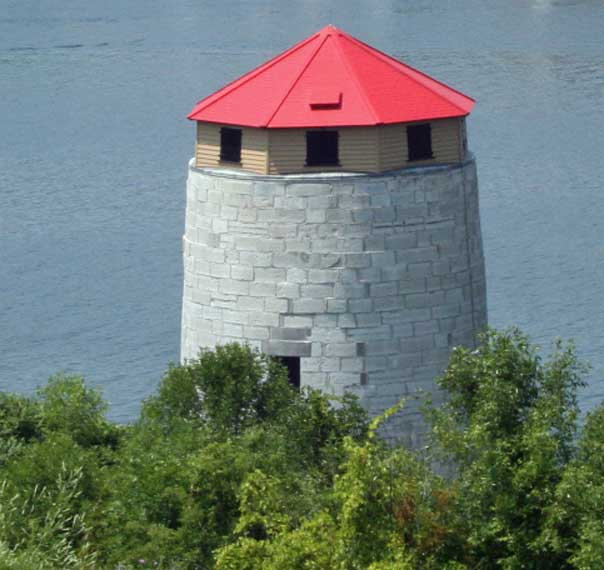
As we approached Kingston and our slip at Confederation Basin we could not help but notice several large round block structures with a hint of painted wood near the top and pointy roofs. At first they looked like the round red barns of Indiana but upon closer inspection it was obvious that they were not barns. Before the dock hands had even finished tying our lines, I was asking a millions questions about these buildings, especially since there was one immediately at the end of our pier. I was informed that they are Martello Towers, but simply called Martellos.

They are small defensive forts built in several countries of the British Empire during the 19th century from the time of the Napoleonic Wars onwards. Standing 40 feet high and with two floors inside, they typically had a garrison of one officer and 15-25 men. Their round structure and thick walls of solid masonry made them resistant to cannon fire, while their height made them an ideal platform for a single heavy artillery piece, mounted on the flat roof and able to traverse in a 360°arc.

The interior of a classic British Martello tower consisted of three stories. The ground floor served as the magazine and storerooms, where ammunition and provisions were kept. The garrison of approximately twenty-five men lived the first floor. This floor which was divided into several rooms and had fireplaces built into the walls for cooking and heating. The officer and men lived in separate rooms of almost equal size. A well or cistern within the Martello supplied the garrison with fresh water.

The Martello towers were used during the first half of the 19th century, but became obsolete with the introduction of powerful rifled artillery. Nine of the fourteen Martello towers built in Canada still survive today. A common characteristic of Canadian Martello towers was removable cone-shaped roofs to protect against snow.

Six Martello towers were built in the US, but sadly we do not take care of our historical objects and building so only one Martello remains today. It is located in Key West and is currently a botanical garden site.

Fort Henry


Just across a small bay from downtown Kingston are two peninsulas that hold great historical and current day military significance to Canada. The Royal Military College of Canada which is a degree granting university that trains and educates the officers of the Canadian Military Forces all in one location similar to our West Point, Annapolis and Air Force Academy but just combined. This certainly makes sense because then each branch of the armed forces does not have to duplicate services. During our trolley tour we were visited RMC and found it to be very similar in history and tradition to our Annapolis.


Then across another small bay and atop an imposing hill stands Fort Henry. We missed our chance during the trolley tour to hop off at Fort Henry so the next day we took a Kingston City bus that dropped us off at the bottom of the Fort Henry hill. I am not exaggerating when I say that we had to walk 1.25 miles, straight uphill in 100 degree heat. By the time we reached the actual fort at the top of the hill, we were in serious need of liquid refreshment and I have never tasted such good water in my life.


It has been extremely hot this summer thus far and while I thought I was dying of the heat I only had to look at the Canadian students who worked at Fort Henry to represent the soldiers and their families of the day. Their uniforms are authentic and made of 100% wool. Still, the military interpreters known as the Fort Henry Guard did not allow the heat to interfere with their duties and continued to perform the tasks to which they are assigned. We were given a lengthy tour of the fort and all of its interworking’s and history.

The fort was originally was constructed during the War of 1812 when the British anticipated the possibility of a US attack on Point Henry due to Kingston Royal Naval Dockyards which were located adjacent to the Fort. Also to be protected was the vital and strategic shipping route, where the St Lawrence River meets Lake Ontario, so that supplies to Kingston and the rest of Upper Canada remained intact.
Canadian troops then garrisoned the fort until 1891.

During WWI Fort Henry served as a facility for holding Canadian citizens of Ukrainian descent as detainees. Then during WWII the fort was a prisoner-of-war camp for German personnel. Today Fort Henry is a Canadian National Park and is undergoing a complete restoration.